
After the Culture and Health course and the Boston event, IBSA Foundation took part in a new international dialogue in New York, with experts in art, health and public policy.
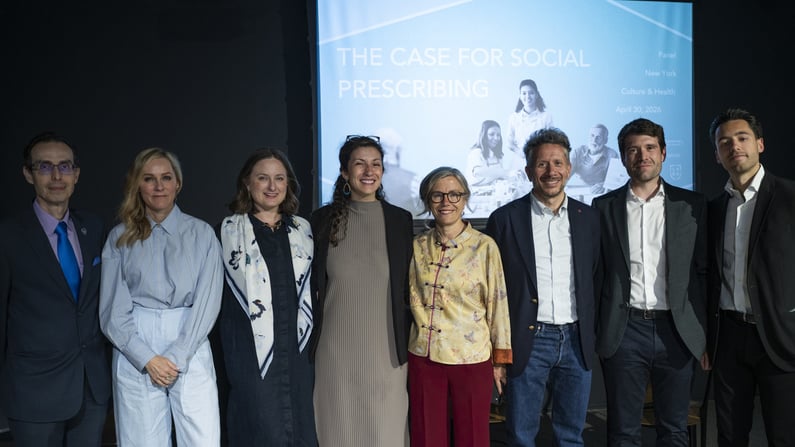
New York, 30 April 2026 – Just days after the Boston event dedicated to adolescent wellbeing and their relationship with the digital world, IBSA Foundation made a stop in New York to explore the topic of social prescribing in depth.
The event The Case for Social Prescribing, hosted by the Swiss Institute in New York and organised in collaboration with Swissnex and the Culture Division of the City of Lugano, brought together researchers, link workers, healthcare and cultural institutions, physicians and businesses active in the United States and Switzerland, in an open dialogue on how social and cultural activities can become instruments of care.
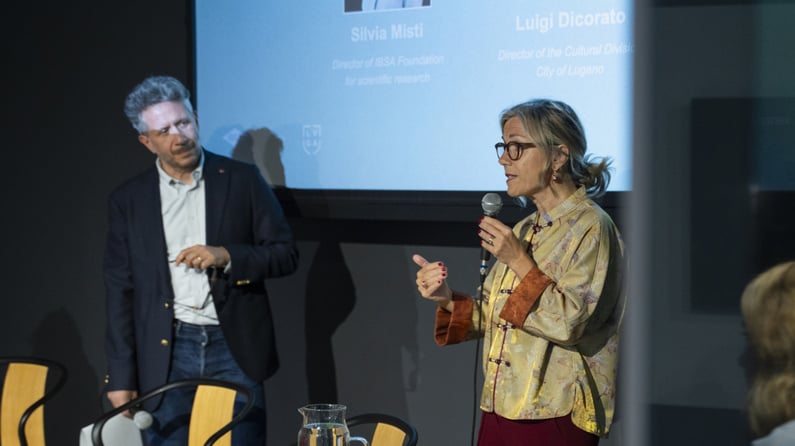
The evening opened with institutional greetings from Swissnex, followed by remarks from Silvia Misiti, Director of IBSA Foundation, and Luigi Di Corato, Director of the Culture Division of the City of Lugano, who presented the pilot project currently underway in Lugano: "Art on Medical Prescription", a clinical study developed in collaboration with the Institute of Family Medicine at USI, the City's Culture Division and LAC – Lugano Arte e Cultura. This initiative translates the principles of social prescribing into personalised cultural pathways, built with physicians and experts and supported by professional link workers, to measure the impact of artistic activities on people's wellbeing.
.
Social prescribing at the heart of the foundation's initiatives
Social prescribing is not, in fact, a new topic for the Foundation. The fifth edition of the university course Cultura e Salute (Culture and Health), promoted by the Faculty of Biomedical Sciences at USI in collaboration with the Foundation and the Culture Division of the City of Lugano, saw — across seven sessions from October to November 2025 — figures from science and culture come together to examine the many faces of social prescribing: from physical activity to contact with nature, from art to volunteering and social inclusion. A theme that the Foundation has also explored and documented on its own website.
Read the article on Social Prescribing
Offering some initial reflections on social prescribing, both at the local level — with a focus on the New York context — and at the international level, was Julia Hotz, award-winning journalist and author of The Connection Cure (Simon & Schuster), the first book to bring together the science and stories of social prescribing. Hotz had previously crossed paths with IBSA Foundation at the Cultura e Salute 2025 course, of which she was a member of the scientific committee alongside Silvia Misiti and Luigi Di Corato.
The panel brought together three American voices: Larissa W. Trinder from NYC Health + Hospitals, Aly Maier Lokuta from NJPAC, and Javier Silva from the Federal Reserve Bank of New York, who contributed an economic perspective.
The speakers discussed the medical, social, and economic dimensions of implementing social prescribing in different local contexts, also exploring the role of public policies and financial systems at the intersection of health and social inclusion.
Particular attention was paid to the ways in which these interventions are structured and implemented: rather than access to cultural activities per se, the focus was on the importance of a guided, personalized program supported by qualified professionals. Through concrete examples, it emerged how elements such as referral mechanisms, long-term support, and the development of tailored programs are crucial to transforming cultural participation into a significant component of the care pathway, distinguishing it from an occasional or purely recreational experience.


The dialogue with the audience
Following the roundtable discussion, a Speakers' Corner gave the audience a voice, inviting them to freely share experiences, reflections, and practices related to the evening's themes, before the networking aperitif concluded the meeting. Rather than a space for questions and answers, the format favored short, direct interventions, where participants could share concrete examples and personal perspectives, actively contributing to the discussion.
Inspired by the tradition of the London Speakers' Corner, reinterpreted in a contemporary way and in the Swiss context, this event fostered an open and participatory dialogue, bringing together individual experiences and collective reflections, continuing the discussion of the panel.
The New York event demonstrated that social prescribing is now a theme capable of bringing cultural institutions, businesses and scientific communities from different countries to the same table. For IBSA Foundation, taking part in this exchange is a further step forward in bridging research and practice, and in promoting a new and innovative way of thinking about care.