

Table of content
-
Art and culture and their impact on health: from humanity's origins to the present day
-
The impact of art begins in the perinatal period, and includes childhood
- Why we can no longer ignore the value of art and culture for health
Can art improve our health? Yes, significantly, according to the latest research.
The book Art Cure: The Science of How the Arts Transform Our Health (2026) is one of the most comprehensive summaries of the relationship between art, health and wellbeing within the context of contemporary research. It was written by Daisy Fancourt, internationally recognised as one of the leading academics on the relationship between health and the arts, as well as Head of the Social Biobehavioural Research Group at University College London (UCL). She also co-authored, with Saoirse Finn (epidemiology and statistics researcher at UCL), the first Report by the World Health Organisation (no. 67, 2019) on the contribution of the arts to improving health, translated and distributed in Italy by the Cultural Welfare Center (CCW).
Since its publication, Art Cure has been the subject of an intensive programme of presentations in various European countries and in the US, demonstration of the global interest in the topics it covers. The book will be published in Italy by Johan & Levy, which, on the invitation of the CCW, has acquired the rights to the Italian edition and launched a series of publications on culture and health in conjunction with the Rovati Foundation. Nominated for the 2026 Women’s Prize for Non-Fiction, one of the most prestigious international awards, Art Cure systematically brings together a large body of scientific evidence that shows how engagement in the arts can significantly impact physical, mental and social health throughout life.
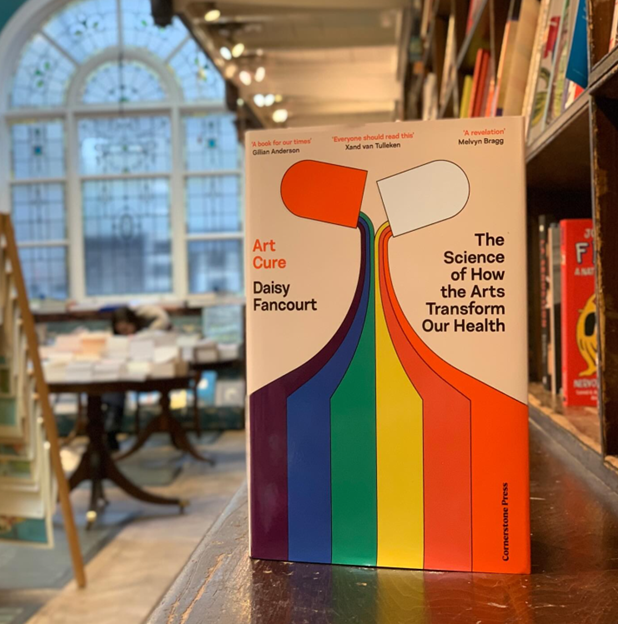
Image: Daunt Books - https://www.facebook.com/photo/?fbid=1320716553409583&set=a.452543020226945
Art and culture and their impact on health: from humanity's origins to the present day
In the contemporary debate on promoting health, the focus tends to be on a set of recommendations for living longer and in better physical condition, shared widely and now firmly embedded in the language of health policy and public communication: regular exercise, a balanced diet, stress management and quality of sleep. Yet, within this context, behaviour that has characterised humanity since its origins remains surprisingly on the margins, despite today being supported by an ever more convincing body of scientific evidence: engagement in art and culture.
Art and health: a look back at the past
Such ideas first appeared in ancient medical and philosophical traditions. In classical Greece, it was believed that art could reset the balance between the heart and the mind; in Persian philosophy and medicine, Ibn Sina repeatedly referred to art in his encyclopaedia The Canon of Medicine; in Indian systems of medicine, such as Ayurveda, music and images were used to support bodily functions such as digestion.
The idea that artistic and expressive practices can play an active part in our health goes back to ancient times. What seems radical today is their integration into modern western medicine, which over time has progressively excluded art and culture from discussions on health, relegating them to a marginal and recreational role. Art Cure seeks to overturn this and to recognise art as in every way a behaviour that benefits health, on a par with other well-established behaviours, starting with the promotion of health.
Practising art everyday
To understand this perspective, it helps to imagine artistic engagement as a continuum on which there is no clear separation between “ordinary” artistic practices and “therapeutic” ones, but rather a variety of different contexts and intensities.
On this spectrum are, on the one hand, daily, informal and widespread practices: attending concerts or shows, visiting museums, reading for pleasure, making music, dancing, painting, taking part in artistic activities in libraries, schools, parks or community spaces. And, on the other hand, there are structured artistic activities in clinical and healthcare settings, such as creative art therapies and artistic programmes integrated into hospitals and healthcare services. In both cases, scientific evidence shows significant impacts on physical, mental and social health.
Art, culture and health throughout life
Epidemiological studies are one of the most reliable bases for such an interpretation. By analysing large longitudinal datasets, which follow thousands of people throughout their entire lives, epidemiology enables us to observe how specific behaviour affects health over the long-term. Research conducted in over sixteen countries shows that, taking a broad set of demographic, social, health and behavioural variables into account, people who regularly engage in artistic activities experience fewer symptoms of depression, improved self-rated health, an increased level of happiness and greater life satisfaction (Mak et al., 2023).
The benefits of art for health
Many benefits have been observed involving various aspects of health, including:
-
a reduction in the incidences of chronic pain;
-
a slowing down of the development of frailty with ageing;
-
an improved retention of cognitive functions over time;
-
a reduced risk of developing dementia;
-
greater longevity overall.
In some cases, the extent of these effects is comparable to that of widely recognised health behaviours, such as physical exercise. For example, the reduction in the risk of developing chronic pain is similar for those who practice artistic activities as for those who do regular physical exercise, despite the public focus historically being almost exclusively on the latter.
Art and care pathways
If artistic engagement in our everyday lives produces long-term benefits, the impact of art is even more evident when integrated into care pathways. Within a clinical setting, art is not a substitute for traditional treatments, but can enhance their effects. Studies conducted in Finland show that adults with clinically diagnosed depression who undergo music therapy, in addition to psychotherapy and pharmacotherapy, show a significantly greater improvement in symptoms over the following six months compared to those who only receive traditional treatments (Erkkilä et al., 2011).
Analogous benefits also arise in certain neurological conditions, such as dementia: listening to familiar music encourages mnemonic memory, so improving both factual recall and the ability to remember lived events.
Positive effects are also observed in Parkinson's disease: regular participation in dance activities helps to stabilise the decline in motor skills, with clinically significant improvements already visible after three months (Simpkins & Yang, 2023). Not by chance, there are today hundreds of communities worldwide offering Dance for Parkinson's programmes. One significant example is the Dance Well programme, launched in Bassano del Grappa, Italy, which offers dance sessions for people with Parkinson's within a cultural setting.
The impact of art begins in the perinatal period, and includes childhood
The impact of artistic engagement does not only concern adults or the elderly. Evidence shows that art has measurable benefits in the very early stages of life.
In children with cerebral palsy characterised by hemiplegia, therapy that integrates rehabilitation exercises into artistic activities – such as learning magic tricks designed to stimulate the use of both hands – can lead to significant improvements in motor function (Fancourt et al., 2020). After just two weeks, the vast majority of children show progress, much of which is maintained over time. Neuroimaging techniques confirm that such changes are accompanied by a reorganisation of brain activity, with an increase in the activation of areas dedicated to controlling the affected hand.
Art in educational contexts
Outside of clinical and healthcare contexts, art also has a significant impact in educational and social settings and for vulnerable individuals, such as prisoners. Taking part in extracurricular artistic activities, through targeted programmes, is associated with an improvement in the management of bullying and with a reduction in aggressive behaviour and school absenteeism. In some prison systems, projects such as Shakespeare Behind Bars, in which prisoners take part in theatre initiatives, lead to a significant reduction in reoffending rates among participants, highlighting the potential of artistic practices to encourage reflection and social reintegration.
The extent and variety of these impacts can be explained by the numerous mechanisms that are activated by artistic engagement. Artistic activities combine components also found in other health behaviours – physical exercise, cognitive stimulation and social interaction – with distinctive elements: multi-sensory stimulation, aesthetics, creativity and imagination. These components work on four levels:
1. Neurobiological level
From a psychological perspective, artistic engagement contributes to the satisfaction of basic needs - ability, autonomy and realisation. It helps in making sense of experiences, in constructing meaning and strengthening personal identity, while also offering protection for stigmatised identities, such as that of the “patient”.
2. Psychological level
Dal punto di vista psicologico, l’engagement artistico contribuisce alla soddisfazione di bisogni fondamentali - competenza, autonomia e relazione. Aiuta a dare senso alle esperienze, a costruire significato e a rafforzare l’identità personale, offrendo anche una protezione rispetto a identità stigmatizzanti, come quella di “paziente”.
3. Social level
At the social level, shared participation in artistic activities creates opportunities for social encounters, collaboration and mutual recognition, which help to develop a sense of belonging and group cohesion. These processes are also supported by biological responses associated with wellbeing, that make the shared experience emotionally significant and facilitate the formation of more stable relationships.
4. Biological level
At the biological level, regular engagement is associated with improved stress management, reduced inflammation, a healthier metabolism and slower brain ageing, reflected in indicators of biological and epigenetic age.
Why we can no longer ignore the value of art and culture for health
Despite all this, artistic and cultural engagement remains low and unequal. In many countries, only a small percentage of the population actively devotes time to the arts. Access is strongly influenced by socio-economic position and by public policies, with cuts to cultural expenditure that ignore the consequences for collective health. And yet, initiatives such as social prescribing programmes, already present in many countries, show it is possible to expand access and generate significant benefits, including in economic terms, reducing the use of healthcare services and improving the quality of life.
Art Cure thus proposes a re-conceptualisation of artistic and cultural engagement as a human behaviour fundamental to health and wellbeing. Just as happened in the past for other now widely established behaviours, artistic and cultural activities that benefit health also appear to be at a turning point. Ignoring this would not only mean missing an opportunity, but would also actively contribute to health inequality and to the progressive demise of everyday artistic engagement.
By Catterina Seia (Presidente CCW – Cultural Welfare Centre) and Elena Rosica ( Cultural Welfare Center (CCW), Research Area)
Further reading:
-
Catterina Seia and Elena Rosica, Bringing a beat to silent surroundings: music, dance and art in prisons, 13 February 2026
-
Catterina Seia and Elena Rosica, Art and health: a proven connection, 25 April 2025
-
Catterina Seia and Marta Reichlin, Flourishing through the arts, 30 April 2024
-
Catterina Seia, Young People: creative expression as an antidote to depression, 30 January 2024
-
Catterina Seia, A growing focus on culture and health, 30 May 2023
-
Catterina Seia and Marta Reichlin, CultureForHealth: 8 major social challenges that art and culture can overcome, 27 December 2022
-
Catterina Seia, Federico Borreani and Massimo Mercelli, Creative Ageing: adding days to life and life to days, 8 December 2021
-
Catterina Seia, The power of music: social therapy, 13 July 2021
-
Catterina Seia and Silvia Misiti, Towards Cultural Welfare, 24 June 2020
-
Catterina Seia, WHO Health Evidence Network: Report 2019, 1 June 2020
-
Catterina Seia, Culture and Health by Catterina Seia, 11 May 2020